Open-source as a hiring filter: build the tool the senior dev would download
Open-source developer tools are the most honest job posting you will ever write — the senior dev who downloads yours has passed a filter most hiring processes can't replicate.
The senior Oracle developer you want on your team has been using SQL Developer since 2007. She has a mental model of what “good” looks like for this category. When she evaluates a new tool, she is not reading the marketing copy — she is opening the connection dialog, trying an edge case on an 11g legacy system, and forming an opinion in the first ten minutes.
If she downloads your open-source tool, you have passed her filter. That is harder than it sounds.
There is a specific class of developer who will not put something in their workflow unless it deserves to be there. They have strong opinions formed by years of working with Oracle’s quirks: the optimizer hints you actually need, the PL/SQL patterns that hold across versions, the places where generic tools give wrong answers with enormous confidence. Their bar is high and well-calibrated.
When you publish something as open-source, that developer can read the code before deciding. She will look at how you handle the Oracle Thick mode initialization, whether you actually understand the behavioral differences between 11g and 23ai, whether your AI suggestions are grounded in schema context or just pattern-matched against a training corpus that barely distinguishes Oracle from MySQL. The code is the pitch.
This is the only honest test of product quality I know. No enterprise sales process, no demo environment, no curated benchmark can replicate it. The developer who reads the architecture, looks at the dependency choices, and thinks “these people know what they’re doing” is telling you something a customer survey never will.
And here is the hiring filter part: that same developer is probably someone you want to work with. The people capable of building useful Oracle tooling and the people capable of evaluating it are roughly the same population. Open-sourcing the work is the most efficient signal you can send to both groups simultaneously.
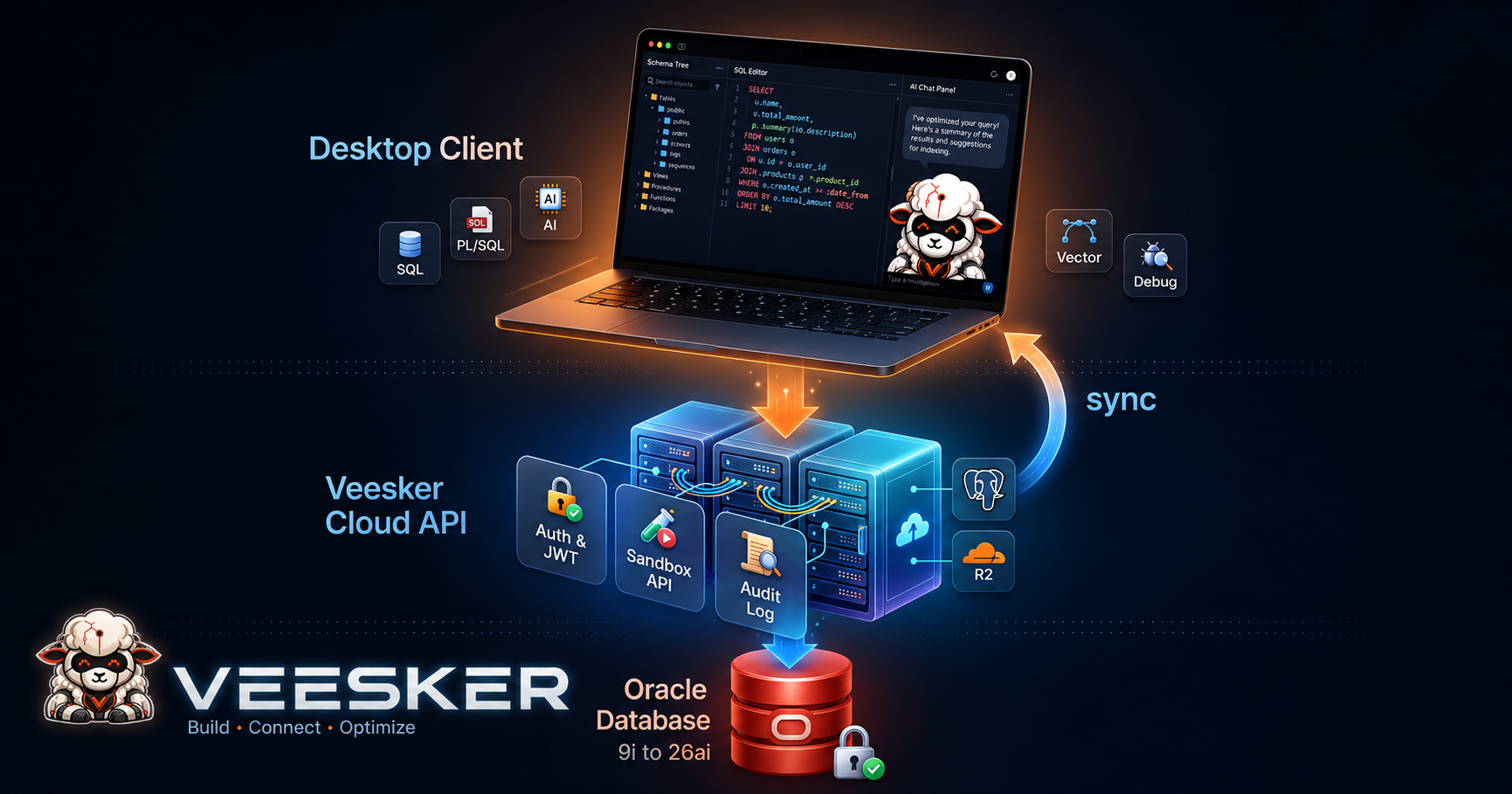
Veesker’s Community Edition is Apache 2.0 for exactly this reason. Not because open-source is a growth hack or a loss-leader funnel strategy. Because if we are building something that a senior Oracle developer would actually put in her workflow, we have to be willing to let her audit the work. The code, the architecture, the decisions we made about local-first data handling, the fact that credentials live in the OS keychain and not a cloud database — all of it is available to read.
The Cloud layer arrives in H2 2026, single tier at $29 USD per seat per month, with founder pricing locked for waitlist members. That part is not open-source, and it does not need to be — but it only makes sense if the foundation already earned the trust.
Build the thing the senior dev would actually download. Everything else follows from that.
— Veesker