What 'good' looks like for a database IDE in 2026
Good is not a feature list. A database IDE is good when it knows the database it is connected to — version, schema, constraints — and adapts.
Good is not a feature list.
When a developer tools company says their product is “good,” it usually means it shipped recently, has a dark mode, and integrates with something that trended on Hacker News. That definition is fine for a text editor. For a database IDE, it is not even a starting point.
A database IDE is good when it knows the database it is connected to. Not databases in general. Not the latest version of the database. The specific database — the version running on your server, the schema in your connected user’s account, the objects that actually exist.
This is a harder problem than it looks.
Most IDEs in 2026 treat the database as a backdrop. You type SQL, the tool sends it, the database either runs it or complains. The tool has no model of what the database contains. It cannot warn you before you run a query that would do a full-scan on an unindexed 200-million-row table. It cannot tell you that the column you are referencing was renamed three migrations ago. It cannot distinguish between “this syntax is valid Oracle” and “this syntax is valid Oracle on the version you are actually running.”
If the tool ships an AI layer on top of that architecture, you get a smarter autocomplete that still does not know your schema. It guesses. Sometimes it guesses right. The rest of the time it hallucinates column names, generates syntax valid in Postgres but not in Oracle 11g, and rewrites bind variables into string concatenation because that is what most of its training data looked like.
Good means grounded. The IDE has read your schema. It knows you are on Oracle 19c, not 23ai, and it does not offer vector search operators that do not exist on your server. It knows what an index exists on, what a constraint says, what a package signature looks like on the version you are using. When it generates SQL, it generates SQL for your database, not for a hypothetical one.
That grounding requires local access. A tool that sends your schema to a remote service to infer completions has moved the hard part out of the IDE and into a cloud API. It may still produce good output. But it has also put your production schema on a server you do not control.
Local-first is not a positioning choice. It is the architecture that makes the grounding honest.
The bar for “good” in 2026 is not high. Know the database. Know the version. Know the schema. Do not invent things the database does not have. Almost nothing in the market clears it.
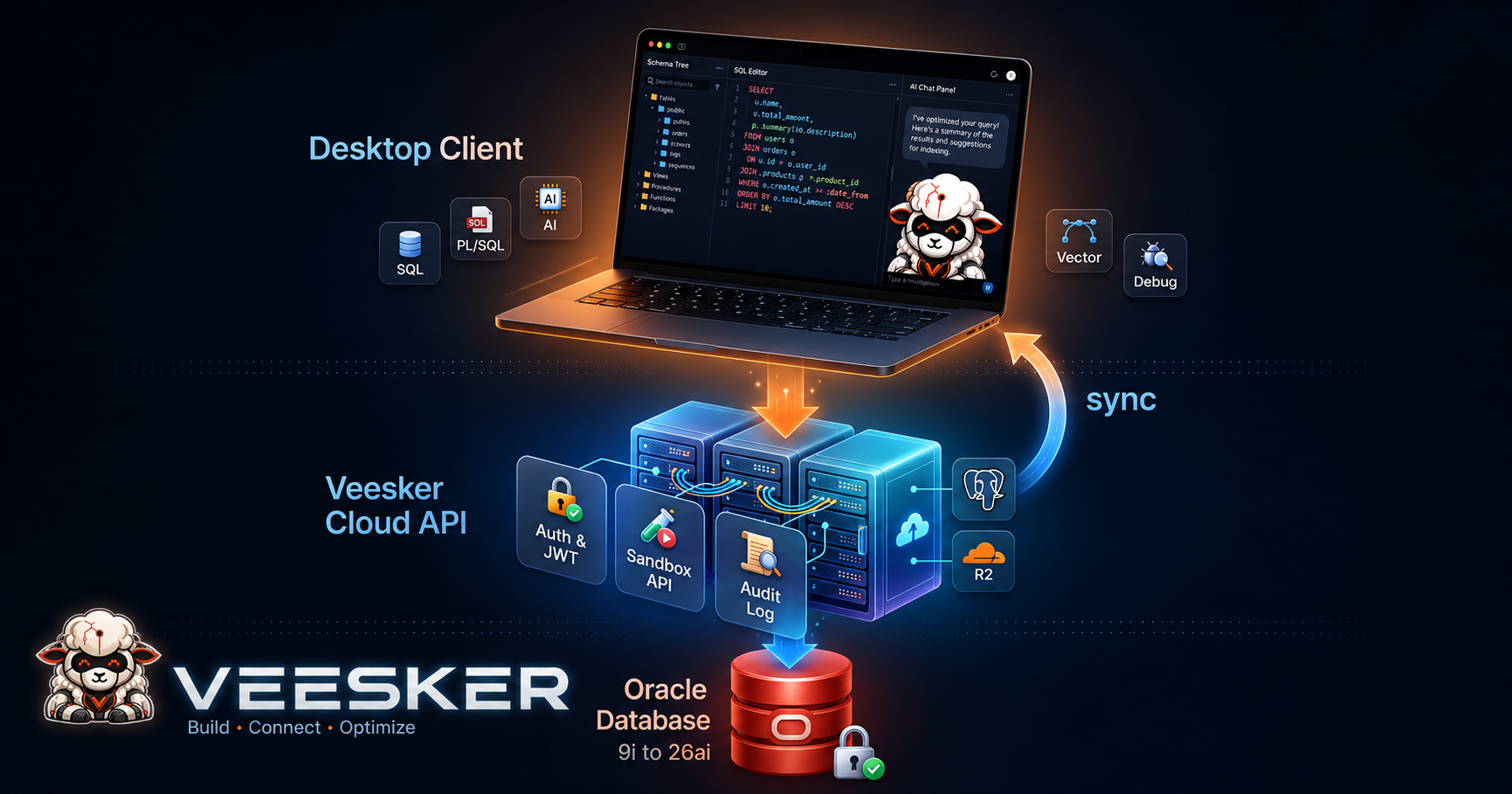
Download Veesker — it ships for Windows, macOS, and Linux, connects to Oracle 9i through 26ai without a separate client install, and reads your schema locally. Community Edition is free under Apache 2.0.
— Veesker